
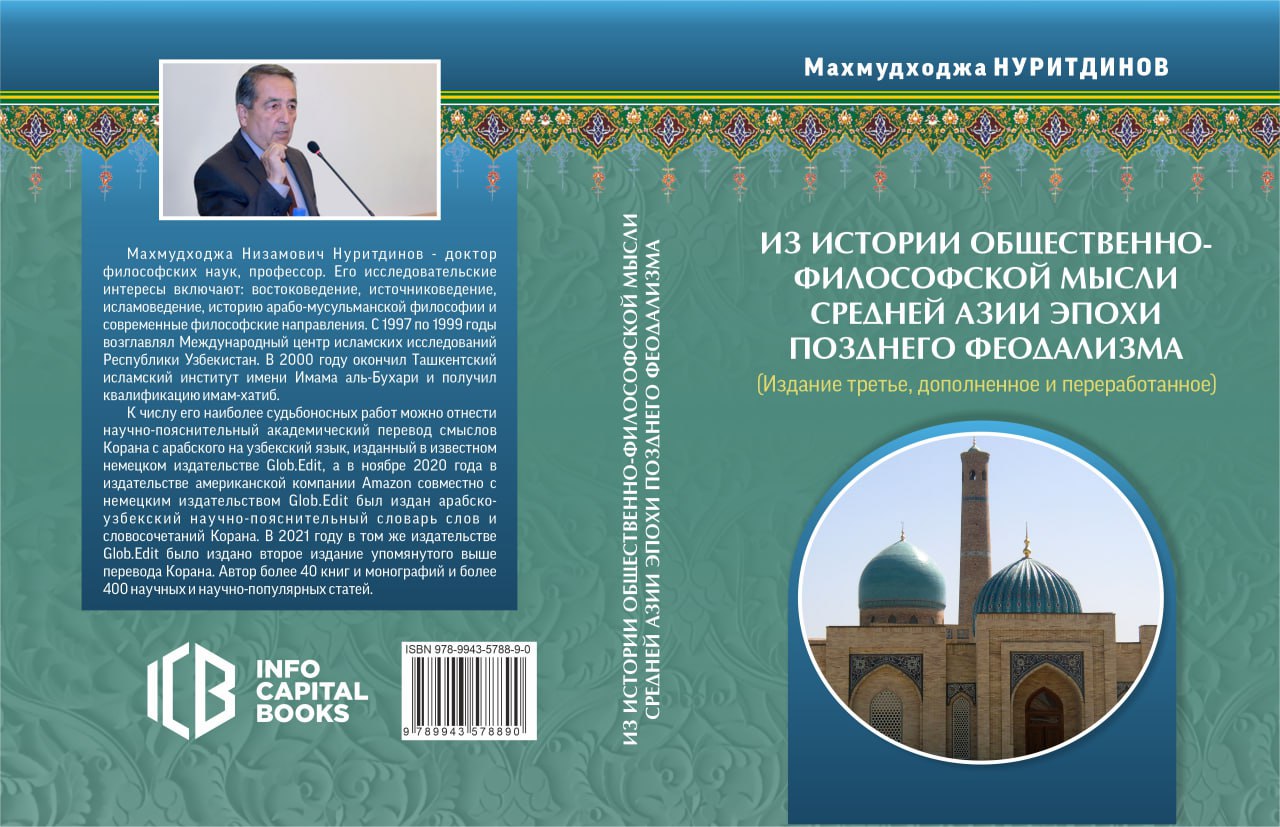
The history of socio-philosophical thought, as part of the history of culture, is undoubtedly of great importance in an objective interpretation, coverage of the history of the formation and development of the spiritual life of society. The period considered by M.N. Nuritdinov (XVI-XVII centuries) refers to the practically unexplored period in the history of Central Asian culture in general and the history of the socio-philosophical thought of Maverannahr in particular.
In our literature, the history of culture of the period after the 16th century was considered little studied. Indeed, in comparison with other periods (VIII-XII and XIV-XV centuries) of research devoted to this historical period, until the beginning of the eighties of the last century, there were no serious studies and even there was no systematic information material. An important merit of M.N. Nuritdinov, first of all, is that he undertook the study of a topic almost not studied in our historical and philosophical literature - a systematic coverage of the history of the social and philosophical thought of the peoples of Maverannahr in the 16th-17th centuries. The study of the philosophical heritage of this period required from the researcher not only deep philosophical knowledge, knowledge of history, but above all the foundations of the Islamic religion, good knowledge of Arabic, Persian and Old Uzbek languages, skills in reading old Arabic manuscripts, etc.
The studies of M. N. Nuritdinov introduce into scientific circulation completely new materials, still unknown to the general reader, materials, moreover, of a purely philosophical nature - new names of philosophers, analysis of their heritage, names of philosophical treatises, their translations from Arabic, etc. etc. And this indicates that in Central Asia in the XVI-XVII centuries. widely and seriously dealt with philosophical questions.
The author of the study is credited with reading and translating hundreds of unknown manuscripts of the 16th-17th centuries, written in Arabic and Persian and stored in the manuscript fund of the Institute of Oriental Studies named after Abu Raykhan Beruni of the Academy of Sciences of the Republic of Uzbekistan. Thus, he introduces these manuscripts into scientific use, enriching the humanities with new sources.
Thanks to the work of M. N. Nuritdinov in the history of culture and socio-philosophical thought of the peoples of Central Asia, the names of such major thinkers and scientists as Mirzajan Shirazi, Yusuf Karabagi, Muhammad Sharif Bukhari, Inoyatullo Bukhari, Hussein Khalkhali and others, who played an important role in the development of culture of the XVI-XVII centuries. and made a great contribution to the development of various branches of science of their era.
The author very convincingly shows the role of the Central Asian cultural process during this period, including the historical and philosophical process in the development of Muslim culture in India, starting from the 16th century, with the emergence and establishment of the Baburid Empire there.
The book was published in a small edition, Tashkent-2023, 492 pages, in Russian.